Audio generated by DropInBlog's Blog Voice AI™ may have slight pronunciation nuances. Learn more
Ultraviolet radiation vs air filtration to mitigate virus laden aerosol in an occupied clinical room
Highlights
•
In poorly ventilated environments, GUV can deliver equivalent air changes to portable HEPA filters set at high filtration rates.
•
Upper room GUV devices can be enhanced by increasing air mixing.
•
254 nm GUV was more effective at inactivating SARS-CoV-2 than ϕX174 virions.
•
222 nm GUV was more effective at inactivating both SARS-CoV-2 & H3N2 compared to ϕX174.
Abstract
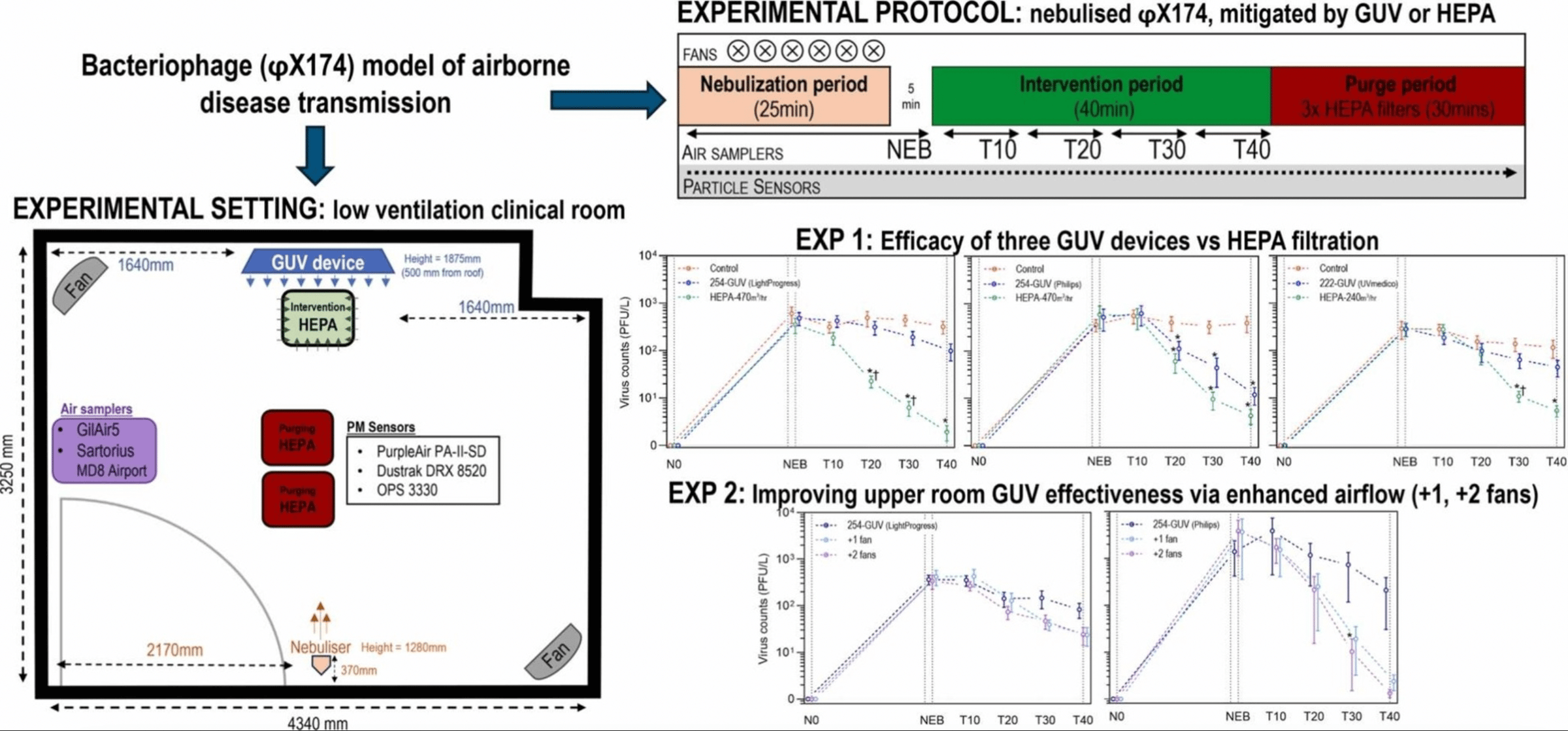
Mitigation measures against infectious aerosols are desperately needed. We aimed to: 1) compare germicidal ultraviolet radiation (GUV) at 254 nm (254-GUVUpper-Room) and 222 nm (222-GUVWhole-Room) with portable high efficiency particulate air (HEPA) filters to inactivate/remove airborne bacteriophage ϕX174, 2) measure the effect of air mixing on the effectiveness of 254-GUVUpper-Room, and 3) determine the relative susceptibility of ϕX174, SARS-CoV-2, and Influenza A(H3N2) to GUV (254 nm, 222 nm).
A nebulizer generated ϕX174 laden aerosols in an occupied clinical room (sealed-low flow).
Mitigation devices (3 commercial GUV devices, HEPA-470m3/hr-class H13 filter) were compared by counterbalanced experimental design with negative (no mitigation) control.
Viral inactivation was determined by air sampling (SartoriusMD8 and Gilair5). Environmental physical properties (airflow, particle matter, GUV irradiance, temperature and humidity) were also characterized.
The effect of improving air mixing on the efficacy of 254-GUVUpper-Room devices was systematically explored by adding fans.
The relative susceptibility of SARS-CoV-2, Influenza A(H3N2) and ϕX174 were assessed by exposure to 254 nm and 222 nm wavelength radiation in a 82 L chamber. 254-GUVUpper-Room with highest irradiance (Philips UV-C WL345W) resulted in highest calculated equivalent air changes per hour (eACH) of 8.18 ± 0.74 (hr−1).
This increased to 19.20 ± 2.45 (hr−1) with the addition of 2 fans. HEPA filtration achieved 11.10 ± 1.25 (hr−1). For 254 nm GUV rank order (most-to-least) of susceptibility was SARS-CoV-2, ϕX174, Influenza A(H3N2), and for 222 nm GUV SARS-CoV-2, Influenza A(H3N2), ϕX174. GUV effectively inactivates virus laden aerosol in poorly ventilated clinical environments. Efficacy is improved by increasing airflow.
HEPA performance is superior to GUV under low flow conditions.