
Using indoor CO2 concentration thresholds to understand and improve the air quality of public buildings: A practical approach
Highlights
- •Indoor CO2 thresholds provide clear identification of poorly ventilated spaces.
- •Occupancy monitoring is key to understanding CO2 data.
- •CO2 based occupancy thresholds can improve indoor air quality.
- •Maximum occupancy densities can be used to directly compare different spaces.
- •Such datasets can be used to quickly identify future ventilation faults.
Abstract
New strategies for assessing and improving indoor air quality, particularly in a manner reducing exposure to airborne pathogens, are required. Monitoring CO2 concentrations within indoor spaces provides a relatively simple means of achieving this.
We aimed to develop a simple approach to tracking CO2 concentrations within a variety of indoor spaces, relating this to the number of occupants within the space, and then using the data to provide recommendations, improving the air quality within the space.
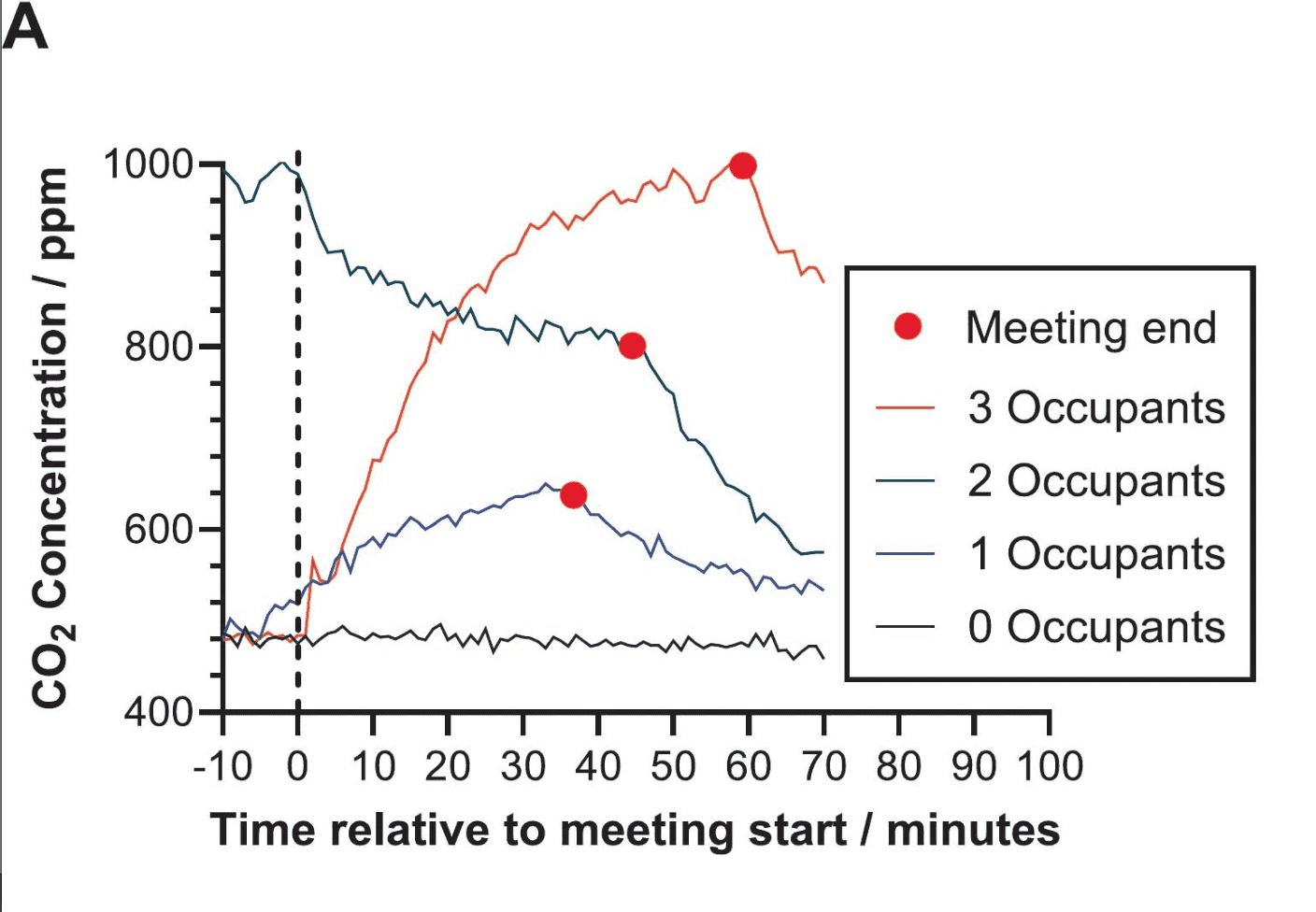
Portable CO2 monitors were used to collect data across an inner-city educational facility. Occupancy data was collected for each space using several methods and then data was processed to extract the steady-state CO2 concentration for each space and level of occupancy.
To allow clearer comparison between different spaces we calculated a parameter we term the ‘OC800’ or occupants per square meter before 800 ppm of CO2 is exceeded. Of the 25 spaces studied, 12 were observed to exceed our desired CO2 threshold of 800 ppm. For each space it was possible to determine the exact level of occupancy which would result in the CO2 exceeding 800 ppm, allowing the assignment of occupancy limits to each space. If a higher level of occupancy was required, it was possible to calculate the relative increase in ventilation needed to achieve this.
The average OC800 across the spaces was 0.3, with an OC800 below 0.2 appearing to indicate problematic spaces.
This approach can be tailored to different locations and CO2 thresholds, providing clear actionable solutions to poor indoor air quality.
To read more click on this link:
https://www.sciencedirect.com/science/article/pii/S0378778825009843