Transmission of respiratory infectious diseases based on real close contact behaviour in an emergency room
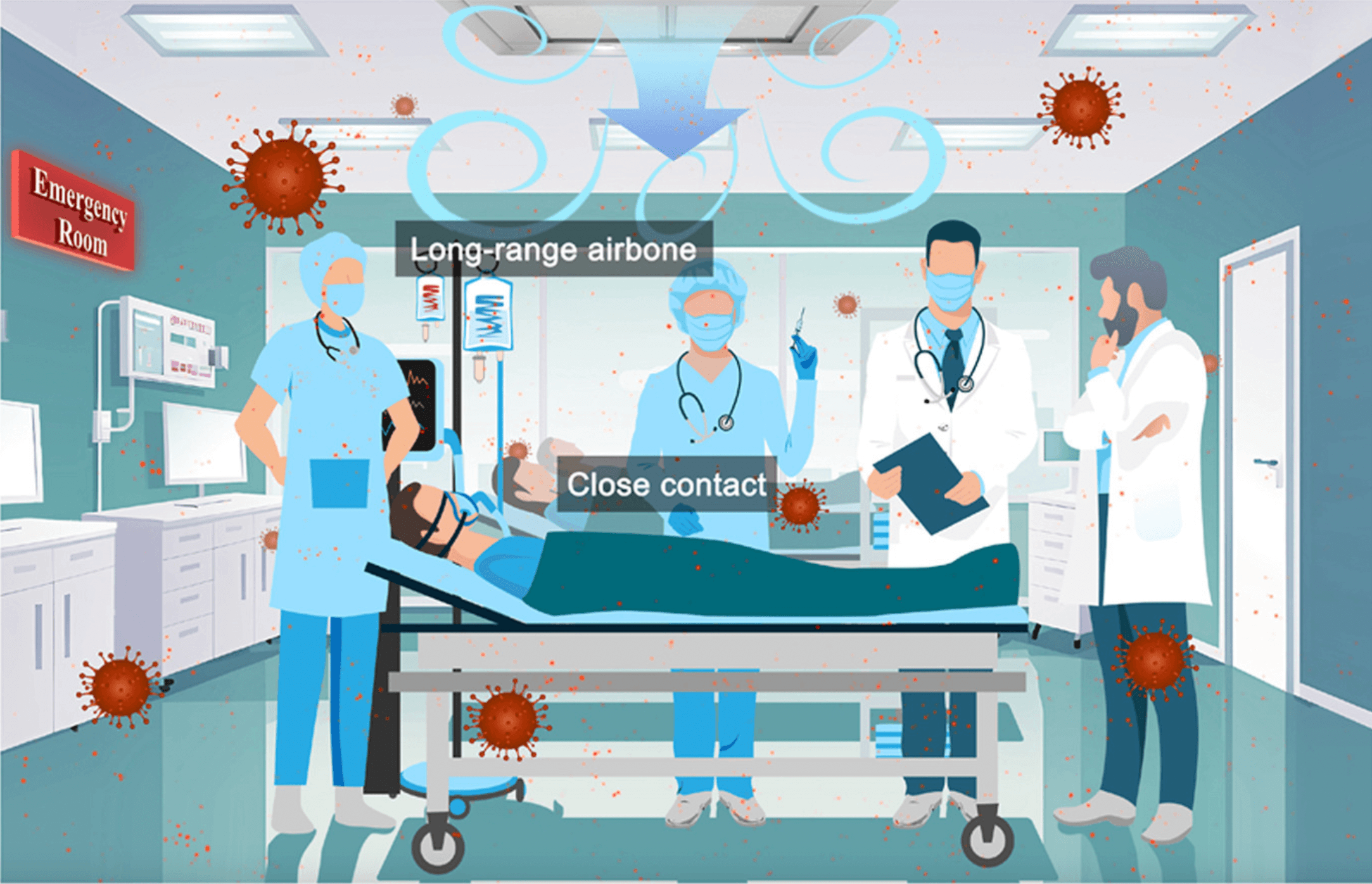
The risk of transmission of respiratory infectious diseases in emergency rooms is high, posing a severe threat to the health of healthcare workers (HCWs).
Methods
The study was conducted in an emergency room of a medical school at a university in Hong Kong during a clinical skills competition. A total of 19,246 s of video surveillance data were collected, recording the treatment of three types of patients (P1: infusion patient, P2: critically ill patient, P3: agitated patient). Taking coronavirus disease 2019 (COVID-19) as an example, a multi-route transmission model was established to assess the infection risk for HCWs and the effectiveness of various interventions.
Results
The average distances between HCWs and patients during the treatment of P1, P2, and P3 were 0.8 (25–75 percentile: 0.6, 1.1) m, 1.0 (0.8, 1.2) m, and 0.5 (0.4, 0.7) m, respectively. When treating P2, due to intubation procedures, the hourly risk of infection was highest at 43.4 % if no HCWs wore masks, which was 5.1 and 3.1 times higher than it during treatment of P1 (8.5 %) and P3 (13.9 %), respectively. During the treatment, without mask protection, the average hourly infection risk for nurses was 11.0 % (P1), 41.2 % (P2), and 16.8 % (P3), which was 1.8 times (P1), 0.9 times (P2), and 1.5 times (P3) that of doctors. If HCWs wear N95 respirators and surgical masks throughout, the total infection risk can be reduced by 94.7 % and 53.9 %, respectively. Increasing the ventilation rate from 1 ACH to 6 ACH reduced the infection risk through long-range airborne transmission by 43.8 % (P1), 36.1 % (P2), and 31.6 % (P3), with a total infection risk reduction of 2.4 % (P1), 5.6 % (P2), and 1.6 % (P3), respectively.
Conclusions
The findings of the study provide a scientific support for the precise prevention and control of respiratory infectious diseases under different treatments in emergency rooms.
For more information click on this link: https://www.sciencedirect.com/science/article/pii/S2468042725000636