
Routes of transmission and their relative importance:
The relative importance will vary with people’s behavior, whether they wear masks and how well fit, whether they go indoors a lot or a little, whether they wash their hands often or not, etc. It will also vary with the setting.
The CDC’s Scientific Brief on transmission of SARS-CoV-2 lists inhalation of very fine droplets and aerosols first among the possible routes of transmission.
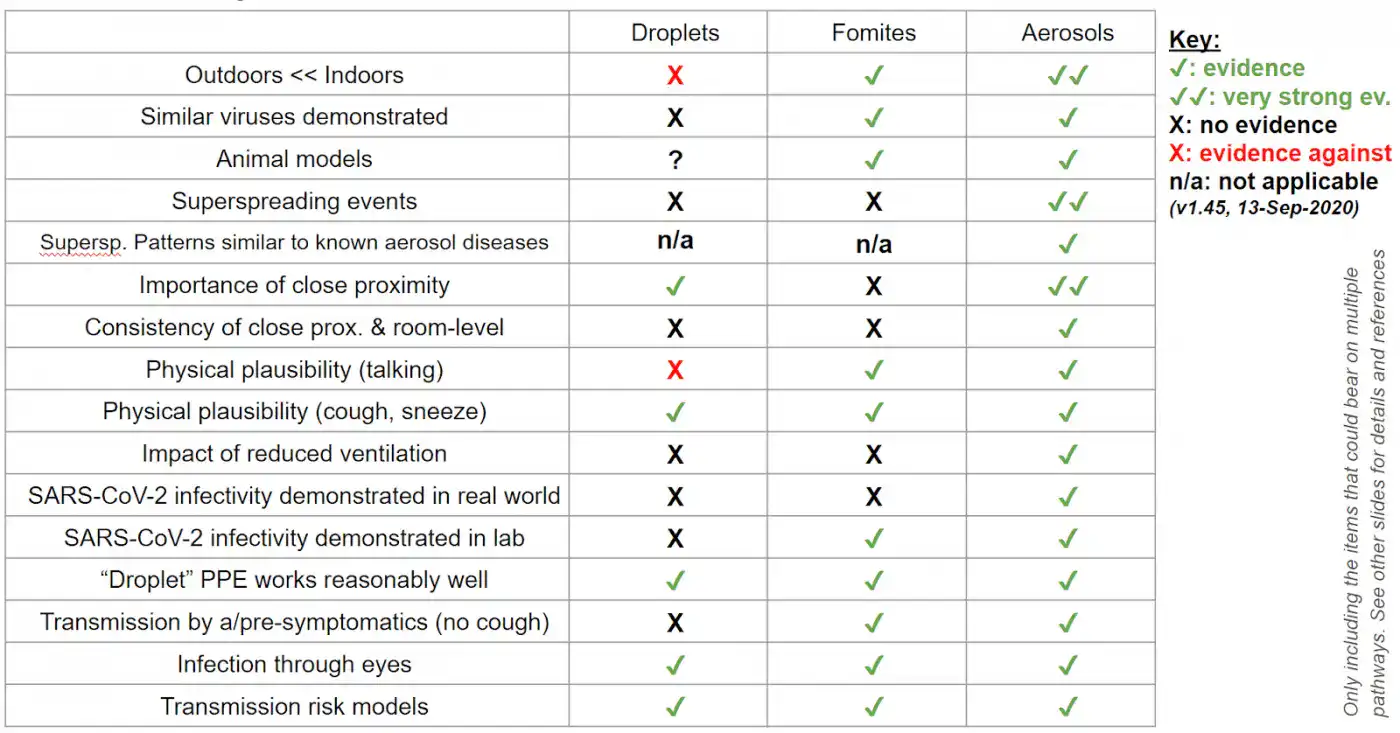
Many scientists, including the authors of these FAQs, think that the aerosol pathway is the dominant route of transmission, with some contribution from fomites and ballistic droplets (from coughing and sneezing). \
This is based on a review of the available evidence, e.g. as summarized in this document and the table below. In particular for this virus there is a lot of transmission by people without (or very few) symptoms.
Those people do not (or rarely) cough, so the usual “ballistic droplet” pathway is very diminished. People are also hyper aware of cough, and it does not seem credible that the pandemic spread is dominated by people coughing and scoring “direct hits” on other people’s eyes/nostrils/mouth.
Many people don’t know how they were infected, and it is unlikely that they wouldn't remember a direct hit by a cough. Transmission by ballistic droplets and fomites are possible but thought to be less important.
For the first year of the pandemic, CDC and WHO promoted large ballistic droplets and contamination of surfaces by them (i.e., fomites) as the main routes of transmission, while downplaying the importance of inhalation of aerosols.
The reasons for the resistance of CDC and WHO to aerosol transmission and their adherence to ballistic droplet transmission despite lack of evidence are rooted in history, including errors in assumptions about traditional transmission routes.