The Evolution of Respirators: How Better Masks Are Becoming Smarter, More Comfortable and Better Fitting
Few technologies became as familiar during the COVID-19 pandemic as the N95 respirator.
Originally designed primarily for occupational settings, respirators rapidly became part of everyday life for millions of people. In the years since, research has confirmed that a well-fitted respirator remains one of the most effective personal interventions for reducing exposure to airborne respiratory pathogens.
But the respirator itself hasn't stood still.
Researchers and manufacturers around the world are now rethinking almost every aspect of respirator design—from comfort and fit to intelligent sensing and personalised manufacturing.
The Biggest Lesson: Fit Matters
Perhaps the most important lesson learned over the past five years is that filtration material is only part of the story.
Even the highest-performing filter can lose much of its protective value if air leaks around the edges of the mask.
Studies consistently show that improving mask fit can dramatically increase the protection a respirator provides. This has shifted attention from simply asking "Which mask should I buy?" to "How well does this mask fit my face?"
Fit Testing Is Becoming More Accessible
For many years, quantitative fit testing was largely confined to hospitals and industrial workplaces.
Today, fit testing is becoming more widely available to healthcare workers, first responders and members of the public.
Modern quantitative fit testing uses specialised instruments to compare particle concentrations inside and outside the respirator while the wearer performs a series of movements. The result is a numerical "fit factor" that objectively measures how well a respirator seals to the face.
Qualitative fit testing—using taste or smell challenge agents—remains a useful and affordable alternative where quantitative equipment is unavailable.
Increasingly, organisations are recognising that regular fit testing is as important as selecting a high-quality respirator.
Visualising Air Leaks
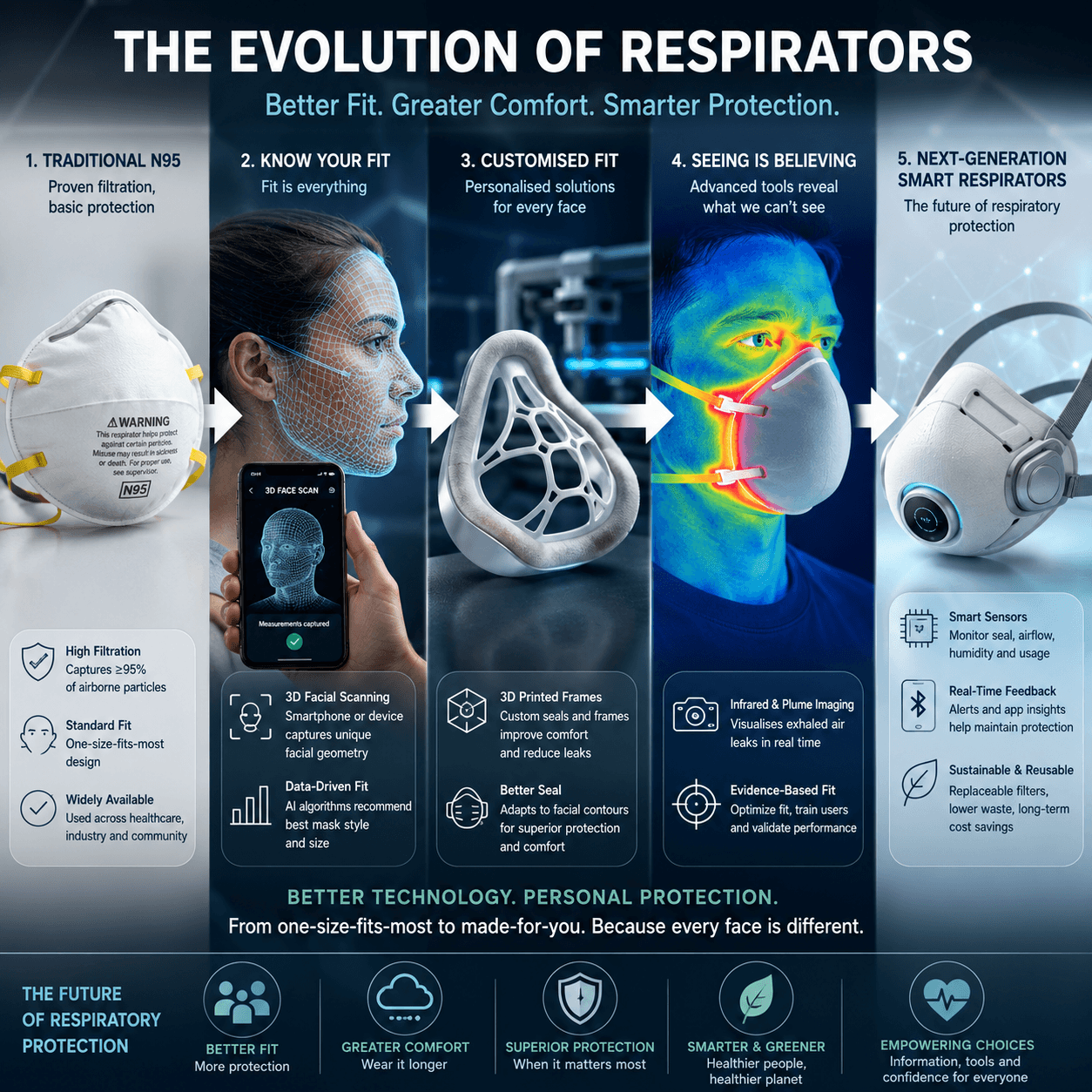
One of the most fascinating developments has been the use of imaging technologies to make otherwise invisible leaks visible.
Infrared thermal imaging, laser light scattering, schlieren imaging and fluorescent aerosol techniques have all been used to visualise how air escapes around respirators during breathing, speaking and coughing.
These tools have become invaluable for:
Improving respirator design.
Educating users.
Demonstrating the importance of correct fitting.
Comparing different respirator styles.
Seeing exhaled air escaping around a poorly fitted mask often has a greater educational impact than simply discussing filtration efficiency.
Personalised Fit Through 3D Technology
No two faces are identical.
Researchers are increasingly using smartphone-based facial scanning and three-dimensional modelling to better match respirators to individual facial geometry.
Several research groups have demonstrated:
Smartphone facial scanning.
AI-assisted facial measurements.
3D-printed custom mask frames.
Personalised sealing components.
Rather than manufacturing thousands of identical respirators, future systems may use facial scanning to recommend the most appropriate design—or even produce customised sealing frames that improve comfort and reduce leakage.
As consumer 3D scanning and printing continue to improve, personalised respiratory protection is becoming increasingly realistic.
Smarter Respirators
The next generation of respirators is also becoming more intelligent.
Prototype "smart respirators" now incorporate sensors capable of monitoring humidity, pressure and respirator fit in real time. Some experimental systems can even detect changes in mask seal and automatically adjust components to improve fit. Although these technologies remain in development, they illustrate how respirators may evolve beyond passive filtration devices into active wearable health technologies.
Comfort Matters
One of the biggest barriers to long-term respirator use has always been comfort.
Manufacturers are responding with improvements including:
Softer sealing materials.
Lower breathing resistance.
Better moisture management.
Improved head strap designs.
Lighter materials.
More breathable internal linings.
These refinements may seem small individually, but together they can significantly improve the willingness of people to wear respirators for extended periods.
What About Exhalation Valves?
Exhalation valves remain an interesting area of discussion.
Valves reduce heat, humidity and breathing resistance inside the respirator, making prolonged wear considerably more comfortable.
Early in the COVID-19 pandemic, concerns centred on the fact that many valves allowed exhaled air to bypass the filter, making them less suitable where protecting others (source control) was a priority.
Since then, manufacturers have explored filtered exhalation valves and other designs that seek to improve comfort while maintaining filtration of exhaled air. This remains an active area of innovation, particularly for reusable respirators and occupational applications.
Reusable Respirators
Another significant trend has been renewed interest in reusable elastomeric respirators.
Once largely confined to industrial workplaces, these devices are increasingly being considered for healthcare and other environments because they offer:
Excellent facial seals.
Replaceable filters.
Reduced long-term waste.
Consistent performance over time.
As sustainability becomes increasingly important, reusable respiratory protection is likely to play a larger role.
Looking Ahead
Imagine purchasing a respirator in the near future.
Rather than choosing only a size, you might:
Scan your face using your smartphone.
Receive recommendations for the best-fitting model.
Download a digital fit assessment.
Print a personalised sealing frame if required.
Verify the fit using your phone's camera or a compact fit-testing device.
Receive alerts if the seal deteriorates during wear.
What once required specialist occupational health equipment may eventually become available to anyone.
Respirators Are Becoming Personalised
The future of respiratory protection isn't simply about higher filtration efficiency.
It's about achieving the best possible combination of:
Filtration.
Fit.
Comfort.
Wearability.
Sustainability.
Personalisation.
These advances recognise an important truth: the best respirator is not simply the one with the highest laboratory filtration efficiency—it's the one that people can wear comfortably, consistently and with confidence.
As respiratory protection continues to evolve, respirators are becoming more than pieces of personal protective equipment.
They are becoming intelligent, personalised devices designed to help people breathe more safely wherever they live, work and learn.