Still Masked, Still Right: A Data-Driven Case for Vigilance
This brief was prepared to support patients who continue to take precautions against SARS-CoV-2 and/or report symptoms that may be downplayed. The evidence summarized below reflects current peer-reviewed science on the effects of SARS-CoV-2 on the brain, immune system, cardiovascular system, and overall functioning—even after mild or asymptomatic infection.
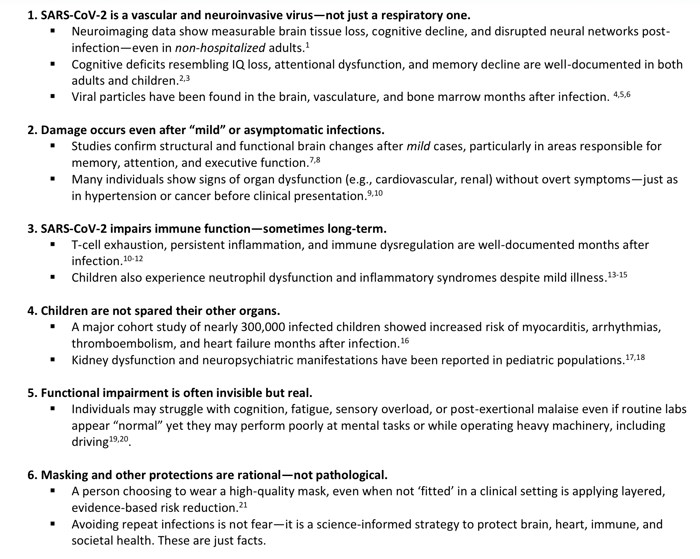
1. SARS-CoV-2 is a vascular and neuroinvasive virus—not just a respiratory one.
▪ Neuroimaging data show measurable brain tissue loss, cognitive decline, and disrupted neural networks post-infection—even in non-hospitalized adults.1
▪ Cognitive deficits resembling IQ loss, attentional dysfunction, and memory decline are well-documented in both adults and children.2,3
▪ Viral particles have been found in the brain, vasculature, and bone marrow months after infection. 4,5,6
2. Damage occurs even after “mild” or asymptomatic infections.
▪ Studies confirm structural and functional brain changes after mild cases, particularly in areas responsible for memory, attention, and executive function.7,8
▪ Many individuals show signs of organ dysfunction (e.g., cardiovascular, renal) without overt symptoms—just as in hypertension or cancer before clinical presentation.9,10
3. SARS-CoV-2 impairs immune function—sometimes long-term.
▪ T-cell exhaustion, persistent inflammation, and immune dysregulation are well-documented months after infection.10-12
▪ Children also experience neutrophil dysfunction and inflammatory syndromes despite mild illness.13-15
4. Children are not spared their other organs.
▪ A major cohort study of nearly 300,000 infected children showed increased risk of myocarditis, arrhythmias, thromboembolism, and heart failure months after infection.16
▪ Kidney dysfunction and neuropsychiatric manifestations have been reported in pediatric populations.17,18
5. Functional impairment is often invisible but real.
▪ Individuals may struggle with cognition, fatigue, sensory overload, or post-exertional malaise even if routine labs appear “normal” yet they may perform poorly at mental tasks or while operating heavy machinery, including driving19,20.
6. Masking and other protections are rational—not pathological.
▪ A person choosing to wear a high-quality mask, even when not ‘fitted’ in a clinical setting is applying layered, evidence-based risk reduction.21
▪ Avoiding repeat infections is not fear—it is a science-informed strategy to protect brain, heart, immune, and societal health. These are just facts.
This summary reflects peer-reviewed research from top-tier journals and global experts.
For references and printable fact sheet please click here.
Fact Sheet Prepared by:
Sean P. Mullen, PhD
Associate Professor, Health and Kinesiology
Director, Exercise, Technology, and Cognition Lab
University of Illinois Urbana-Champaign