

Table of Contents
- 1. The hardest part of innovation isn't coming up with good ideas. It's helping them become the new normal.
- 2. Why Good Ideas Don't Become the New Normal
- 3. What AirSpot Taught Us
- 4. The Next Step
- 5. The Next Demonstrations
- 6. What Success Looks Like
- 7. How We'll Measure Success
- 8. Governance & Transparency
- 9. Join the Movement
1. The hardest part of innovation isn't coming up with good ideas. It's helping them become the new normal.
It has taken me more than twenty years to understand why.
As an anaesthetist, I witnessed major adverse events that I believe were preventable. What struck me wasn't simply that they occurred, but how difficult it was for the healthcare system to adopt straightforward ideas that could help everyone succeed.
The problem wasn't a lack of talented people.
It wasn't a lack of evidence.
Too often, it was a failure of adoption.
In 2017, that question led to the creation of the PatientSafe Network.
Its purpose was not simply to improve patient safety, but to understand why complex systems resist change—and how they might learn, collaborate and improve more effectively.
That work expanded into systems thinking, human behaviour, ergonomics, design and the remarkable influence that environments have on the decisions people make.
The projects that followed—including the Theatre Cap Challenge, the successful campaign to standardise 2222 as the internal hospital emergency number, and later AirSpot—may appear very different.
In reality, they are all exploring the same question.
How do good ideas become normal practice?
Each project reinforces the same lesson.
Evidence matters.
Technology matters.
But neither is enough.
People adopt ideas when they are visible, practical, trusted and socially reinforced. Great products help. Beautiful design helps. Open collaboration helps. Strong networks help even more.
AirSpot became the clearest demonstration of that lesson.
What began as the world's smallest wearable CO₂ monitor evolved into an open ecosystem spanning environmental monitoring, collaborative mapping, community programs, research partnerships and real-world implementation. With relatively modest philanthropic support, we demonstrated that healthy indoor air can move beyond awareness into practical action.
More importantly, we discovered something larger.
Healthy indoor air doesn't have an innovation problem.
It has an adoption problem.
The knowledge already exists.
The technologies already exist.
Outstanding organisations around the world are already doing exceptional work.
The opportunity now is to help those and other new great ideas spread further, faster and more effectively.
That is the purpose of the Indoor Clean Air Adoption Network (ICAAN).
ICAAN is not a departure from the work that came before it.
It is the natural evolution of everything we've learned.
Our ambition is simple: build the shared infrastructure that helps the best healthy indoor air ideas resonate, connect and scale—so that together they achieve far more than any one organisation could accomplish alone.
2. Why Good Ideas Don't Become the New Normal
Every successful innovation follows the same journey.
It begins as an idea.
Then it becomes evidence.
Only much later—if it ever does—it becomes everyday practice.
The gap between evidence and everyday practice is where most good ideas stall.
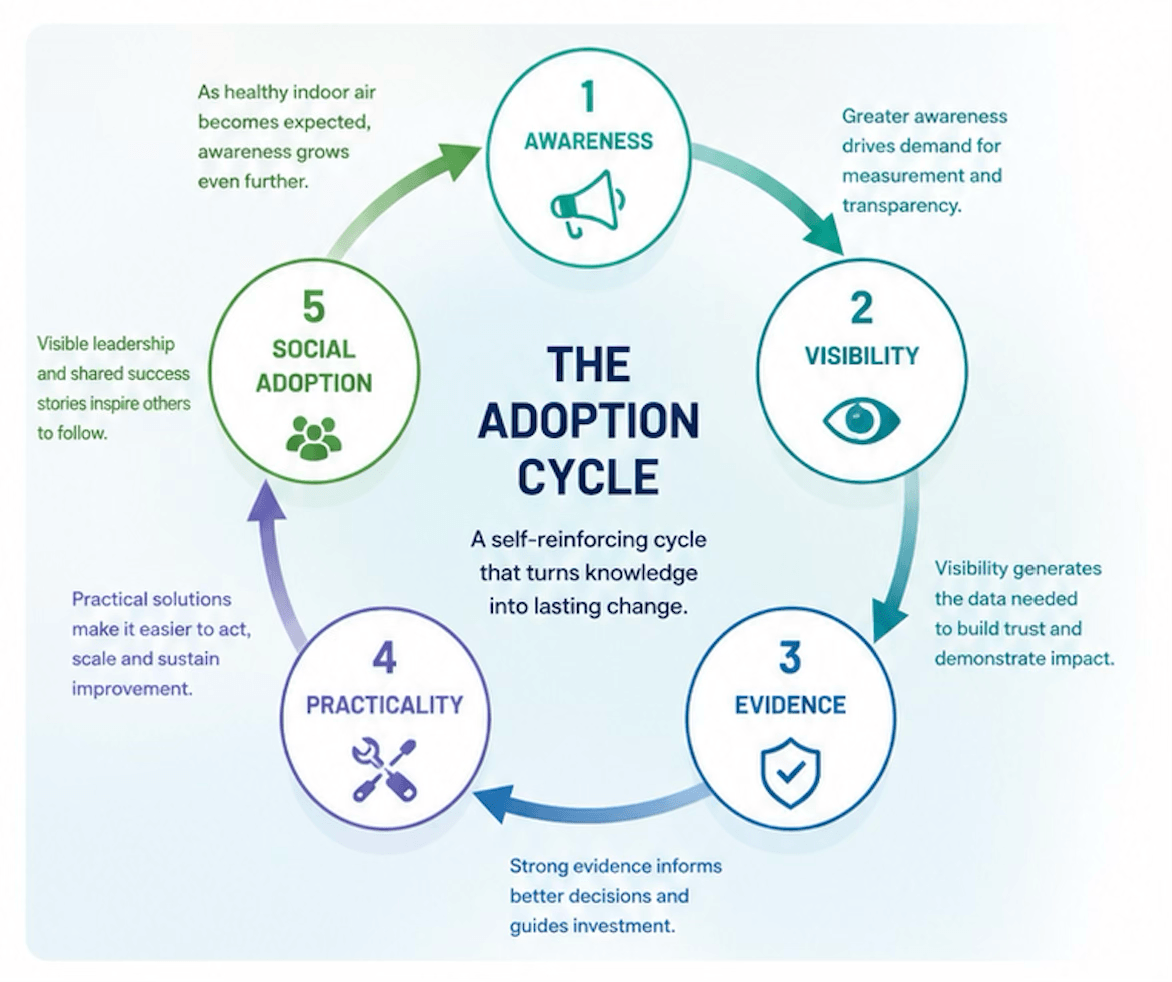
Over the past two decades, we've come to believe there are five reasons why.
A. People don't know.
The first barrier is awareness.
People cannot improve something they don't know exists.
B. People can't see it.
Indoor air is invisible.
Measurement transforms an invisible problem into something people can understand, discuss and improve.
C. People need confidence.
Evidence is essential.
But evidence alone rarely changes behaviour.
People are reassured when they see successful implementation in places they trust.
D. People need practical solutions.
Even the best ideas fail if they are expensive, complicated or difficult to implement.
Adoption requires simplicity.
E. People follow people.
Perhaps the strongest force of all is social adoption.
Schools learn from schools.
Hospitals learn from hospitals.
Businesses learn from businesses.
Communities follow trusted organisations.
Elite athletes influence millions.
Good ideas become expected when enough respected people begin treating them as normal.
That is how cultures change.
Healthy indoor air is no different.
The science is progressing.
The technology is progressing.
Now the opportunity is to accelerate adoption.
Not by building another product.
But by making the best ideas easier to discover, easier to trust and easier to adopt.
That is the problem ICAAN exists to solve.

3. What AirSpot Taught Us
AirSpot began with a simple question.
How do we make healthy indoor air easier to adopt?
The goal wasn't another CO₂ monitor.
It was to reduce the friction between knowing and acting—creating something people would genuinely want to carry, wear and use every day.
That thinking quickly expanded beyond hardware.
We built an open ecosystem of technology, mapping, research partnerships, community programmes and real-world demonstrations.
Working with elite sports teams such as the Sydney Roosters reinforced another important lesson.
Healthcare remains central to our work, but widespread adoption also requires environments that actively embrace innovation and inspire others to follow. Success in elite sport resonates far beyond the playing field.
Over the past five years, we've shown what is possible with limited resources.
We've built the foundations.
We know how much further they can go.
We also know that many other innovators, researchers and organisations face the same challenge: helping good ideas become adopted and ultimately expected.
The next step is to build the ecosystem that helps them succeed—together.
4. The Next Step
The more we learned, the clearer the next step became.
No single organisation will make healthy indoor air the new normal.
Researchers generate evidence.
Innovators build better technologies.
Schools, hospitals and workplaces demonstrate what is possible.
Communities build awareness.
Philanthropists accelerate progress.
Each plays an essential role.
Yet too often they work in parallel rather than together.
We believe the greatest opportunity is no longer creating isolated successes.
It is connecting them.
We call this next step the Indoor Clean Air Adoption Network (ICAAN).
ICAAN is not another clean air organisation.
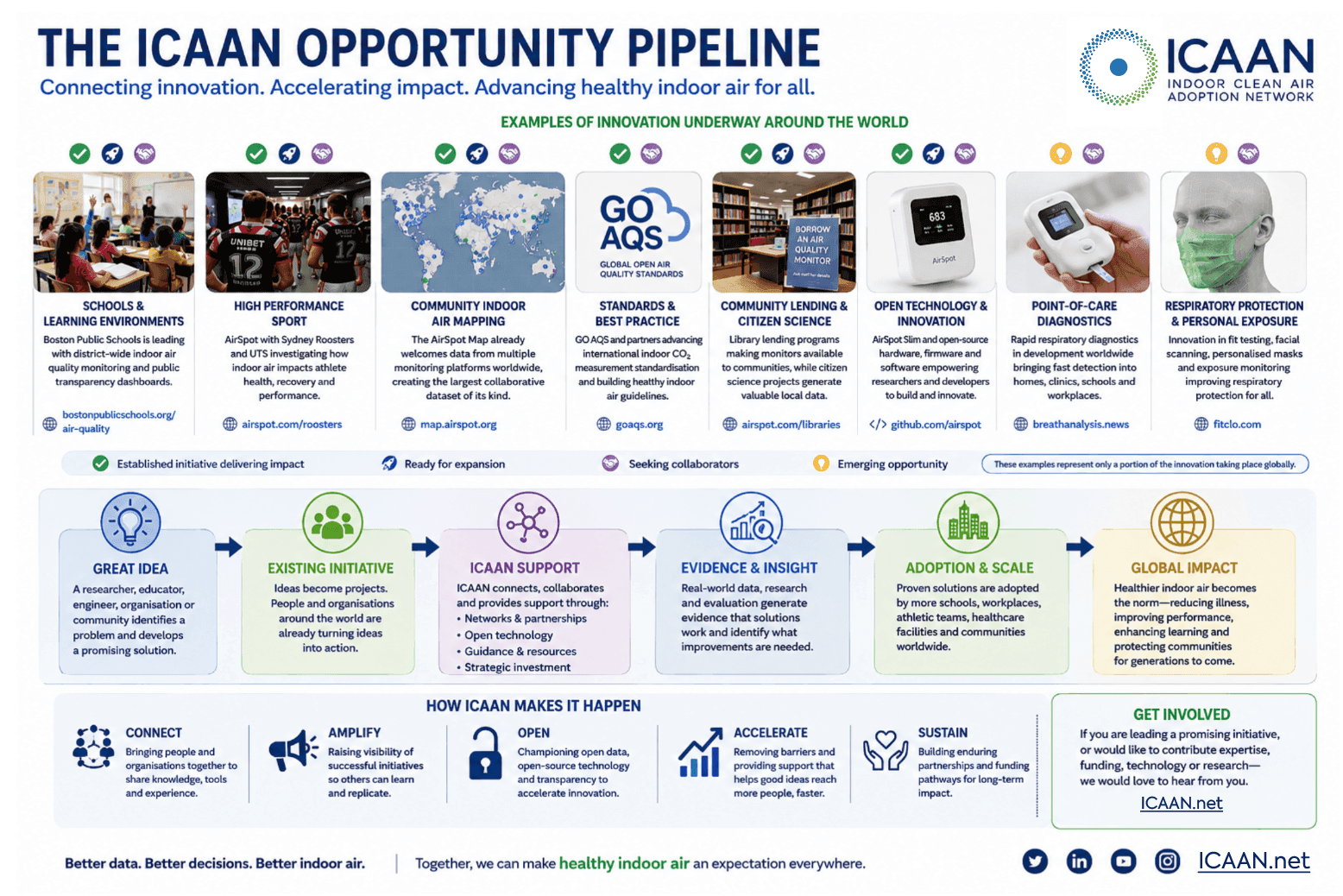
It is a collaborative platform designed to help great ideas become visible, trusted, adopted and ultimately expected.
It will connect people, projects and organisations.
It will openly share knowledge, celebrate success, reduce duplication and help the best ideas resonate further.
Its success will not be measured by the size of the network itself.
It will be measured by the success of the people and organisations it helps.
5. The Next Demonstrations
ICAAN will grow by strengthening collaboration and delivering practical initiatives that others can build upon.
Our initial focus is five flagship initiatives.
A. Connect ICAAN
Make the movement easier to discover, connect and support. Develop the ICAAN website, collaboration platform and public dashboard, showcasing projects underway, highlighting opportunities for collaboration, and helping researchers, innovators, organisations, funding partners and communities find one another.
B. ICAAN Map
Expand the existing collaborative map into shared global infrastructure, welcoming data from every compatible monitoring platform and making healthy indoor air more visible, measurable and actionable.
C. AirSpot Slim
Most people carry smart phones. Until air quality monitoring is built into them the AirSpot Slim device delivers the next best thing. A credit card sized device which magnetically attaches to the back of a smartphone and can be encompassed within bespoke phone cases taking up no additional space in a person's daily life.
D. Elite Athlete Initiative
Partner with elite sporting organisations and universities to evaluate how maximising clean indoor air influences health, recovery and performance using environmental monitoring, wearable physiological metrics and coach dashboards.
E. The Indoor Air Operating System
The Indoor Air Operating System makes monitoring and improving indoor air quality as simple as connecting to Wi-Fi by seamlessly integrating AirSpot monitors, AirSpot Gateways, cloud dashboards, AI-powered recommendations and real-time alerts into a single, easy-to-use platform. Designed for schools, workplaces, healthcare facilities and community spaces, it transforms buildings into intelligent, healthier environments while enabling organisations to demonstrate their commitment to clean indoor air through the ICAAN/AirSpot Map.
These are only the first demonstrations.
Our ambition is for ICAAN to become the place where great ideas are discovered, connected, advanced and ultimately adopted.
6. What Success Looks Like
Success is when healthy indoor air becomes unremarkable because it is simply expected.
Success is children growing up expecting clean indoor air wherever they learn, play and train.
Success is organisations proudly measuring and improving the air people breathe.
Success is healthy indoor air becoming as normal to discuss as lighting, temperature or drinking water.
Success is researchers, innovators and communities building upon one another's work rather than working in isolation.
Success is new technologies reaching more people because they are easier to discover, evaluate and adopt.
Success is demonstration projects inspiring others to follow.
Success is a global community that learns faster because knowledge is openly shared.
Ultimately, success is not measured by the size of ICAAN.
It is measured by how little the world needs to talk about healthy indoor air because it has simply become the expected way of living.
7. How We'll Measure Success
Healthy indoor air adoption should be measurable.
ICAAN will openly report its progress using practical indicators that reflect real-world impact rather than organisational growth.
Success includes:
More organisations measuring and improving indoor air.
More successful projects openly shared and replicated.
More researchers, innovators and communities collaborating.
More monitoring platforms contributing to shared infrastructure.
More evidence demonstrating the health, wellbeing and performance benefits of healthy indoor air.
More people expecting healthy indoor air wherever they live, learn, work and play.
These measures will continue to evolve.
Our commitment is that progress will be transparent, openly communicated and judged by the impact we help create.
8. Governance & Transparency
Trust is built through openness.
As ICAAN grows, we are committed to:
Working openly wherever possible.
Collaborating before competing.
Celebrating the success of others.
Communicating progress regularly and transparently.
Continually learning and adapting as better ideas emerge.
Where appropriate, technology, data, educational resources and standards will be developed openly to maximise their benefit to the wider community.
Our goal is simple:
Help great ideas become visible, trusted, adopted—and ultimately expected.
9. Join the Movement
No single organisation will make healthy indoor air the new normal.
It will happen because researchers, innovators, educators, healthcare providers, sporting organisations, communities, industry leaders and philanthropists choose to work together.
If you're already helping improve healthy indoor air, we'd love to hear from you.
Whether you're developing new technology, generating evidence, delivering a successful program, or simply looking for ways to contribute, ICAAN aims to help you connect, collaborate and amplify your impact.
The foundations have already been laid.
Now it's time to make healthy indoor air unremarkable because it is simply expected.