
Looking Beyond Acute Illness
Over the past six years, public discussion about COVID-19 has increasingly focused on a single question:
"How severe is it?"
Yet severity is only one part of the story.
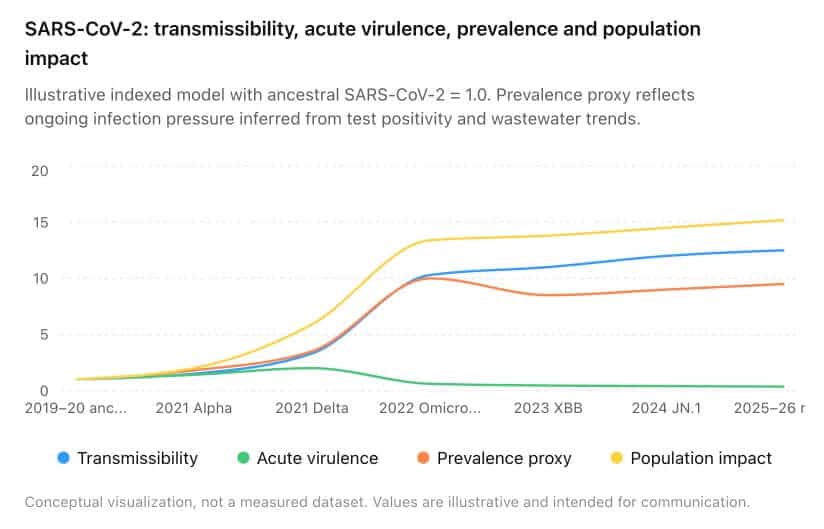
To better understand where we are today, it can be useful to consider four related concepts:
Transmissibility
Prevalence
Population Impact
Acute Virulence
Taken together, these measures help explain why some people remain deeply concerned about its long-term consequences.
Understanding the Terms
Transmissibility
Transmissibility refers to how easily a virus spreads from one person to another.
It is commonly estimated using measures such as:
Basic reproduction number (R₀)
Effective reproduction number (Rₜ)
Growth advantage of new variants
A virus with high transmissibility infects more people, more quickly.
Since the emergence of SARS-CoV-2, transmissibility has increased dramatically as the virus has evolved through Alpha, Delta, Omicron and subsequent variants.
Prevalence
Prevalence describes how much infection is circulating within a population at a given time.
Historically this has been estimated through:
PCR test positivity rates
Community surveillance studies
Wastewater monitoring
Hospital presentations
Wastewater analysis has become particularly important because it captures infections regardless of whether people test or report them.
Despite reductions in testing, wastewater surveillance continues to demonstrate that SARS-CoV-2 remains widespread throughout many communities.
Population Impact
Population impact describes the overall burden a disease places upon society.
It reflects:
Number of infections
Hospitalisations
Disability
Lost productivity
Chronic illness
Premature death
Population impact is not determined by acute virulence alone.
A virus that infects vastly more people can still produce substantial harm even if each individual infection is less severe.
Acute Virulence
Acute virulence refers to the severity of illness caused during the initial infection.
It is commonly assessed using:
Hospitalisation rates
ICU admission rates
Mortality rates
Organ damage during acute illness
While the Delta variant was associated with increased acute severity compared with earlier strains, later Omicron-lineage variants generally appear less likely to cause severe acute disease on a per-infection basis.
This decline in acute virulence may have contributed significantly to the perception by some that COVID is now "mild."
The Long-Term Consequences of COVID
One of the greatest challenges in discussing COVID is that many people continue to view it primarily as a short-term respiratory infection.
Increasing evidence suggests that this framing is incomplete.
Research has linked COVID infection to increased risks of:
Cardiovascular Effects
Heart attack
Stroke
Arrhythmias
Microvascular dysfunction
Increased cardiovascular mortality
Neurological Effects
Brain fog
Cognitive impairment
Memory difficulties
Fatigue syndromes
Increased risk of certain neurological conditions
Immune Dysregulation
Researchers continue to investigate how SARS-CoV-2 affects immune function following infection.
Evidence suggests that infection can alter immune responses and may increase susceptibility to other infections and inflammatory conditions in some individuals.
Long COVID
Long COVID has emerged as one of the defining public health challenges of the pandemic era.
Symptoms may include:
Fatigue
Cognitive impairment
Breathlessness
Dysautonomia
Sleep disturbances
Exercise intolerance
For some individuals these symptoms resolve. For others they persist for months or years.
Importantly, Long COVID is not restricted to those who experienced severe acute illness.
Two Different Views of Reality
Today there appears to be a growing divide between two broad perspectives.
The first view is common:
"COVID is just like the flu now."
People holding this view often see little reason for mitigation measures and may regard concerns about COVID as outdated.
The second view recognises that:
Lower acute severity does not necessarily mean lower long-term harm.
Many people in this group remain concerned about cumulative effects from repeated infections and the implications for public health, healthcare systems and future generations.
The tension between these perspectives increasingly shapes public discussion.
The People Least Able to Change Course
Perhaps the greatest tragedy is that those most likely to be affected often have the least ability to protect themselves.
This includes:
Immunocompromised individuals
People with chronic illnesses
Older adults
People already living with Long COVID
Children
Children, in particular, inherit the decisions made by adults.
They spend thousands of hours in classrooms, sporting facilities and public spaces where air quality is rarely considered despite being one of the most important determinants of respiratory disease transmission.
The Cost of Doing the Right Thing
For many people who continue to take precautions, the burden extends beyond infection risk.
There is often a social cost.
Wearing a well-fitted N95 respirator in a hospital, clinic or crowded indoor space can attract attention despite overwhelming evidence supporting respiratory protection.
Some people experience:
Social isolation
Stigmatisation
Workplace pressure
Exclusion from professional environments
This can be particularly difficult when such experiences occur within institutions whose purpose is to care for others.
The challenge is not simply scientific.
It is social.
Understanding Human Nature
Human beings are profoundly social creatures.
Throughout evolutionary history, remaining part of the group was often essential for survival.
As a result, people frequently align their behaviour with prevailing social norms even when evidence points elsewhere.
This tendency is neither new nor unique to COVID.
History provides many examples where public understanding lagged behind scientific evidence.
What is fashionable is often mistaken for what is true.
What is common is often mistaken for what is safe.
Where AirSpot Fits In
AirSpot was never created simply to measure carbon dioxide.
It was created to help make clean indoor air visible.
When something becomes visible, it becomes understandable.
When it becomes understandable, it becomes actionable.
The AirSpot ecosystem seeks to help people:
Understand indoor air quality
Improve ventilation
Reduce exposure to airborne pathogens
Share information with their communities
Make informed decisions
Through wearable monitors, open-source mapping, education, data sharing and community collaboration, AirSpot aims to contribute to a future where clean indoor air is expected rather than exceptional.
Making Clean Air Fashionable
Hand washing was not always normal.
Clean drinking water was not always expected.
Seat belts were not always worn.
Smoke-free indoor spaces were once controversial.
Each became standard because society eventually recognised the benefits.
Clean indoor air is likely to follow the same path.
The evidence supporting ventilation, filtration and airborne infection control continues to grow.
The challenge is not whether clean air works.
The challenge is whether society chooses to act.
AirSpot's mission is simple:
To help accelerate that transition.
Working alongside researchers, advocates, engineers, health professionals, libraries, schools, businesses and communities, the open AirSpot ecosystem will continue striving toward a future where clean indoor air is visible, understandable, actionable—and ultimately fashionable.
Because breathing clean air should not be a privilege.
It should be normal.