
Skip to content
  • Shop
    • AirSpot Products
    • Supported Products
  • App
  • Map
  • Resources
    • About Us
    • Open Source AirSpot
    • AirSpot Device Instruction Manual
    • AirSpot Device Reviews
    • AirSpot Device Affiliates
    • AirSpot Library Lending
    • Support AirSpot
    • News
    • BreatheSafeAir Forum
    • AirSpot Elite Sport
    • ICAAN
    • Contact
Log in
  • Twitter
  • Facebook
  • Instagram
  • Vimeo
Airspothealth
  • Shop
    • AirSpot Products
    • Supported Products
  • App
  • Map
  • Resources
    • About Us
    • Open Source AirSpot
    • AirSpot Device Instruction Manual
    • AirSpot Device Reviews
    • AirSpot Device Affiliates
    • AirSpot Library Lending
    • Support AirSpot
    • News
    • BreatheSafeAir Forum
    • AirSpot Elite Sport
    • ICAAN
    • Contact
Log in Cart

Item added to your cart

Carbon Dioxide

Carbon dioxide levels reflect COVID-19 risk

AirSpot AirSpot CO2 Monitors | Links
02/13/2025 6:08pm 1 minute read

Listen to article
Audio generated by DropInBlog's Blog Voice AI™ may have slight pronunciation nuances. Learn more

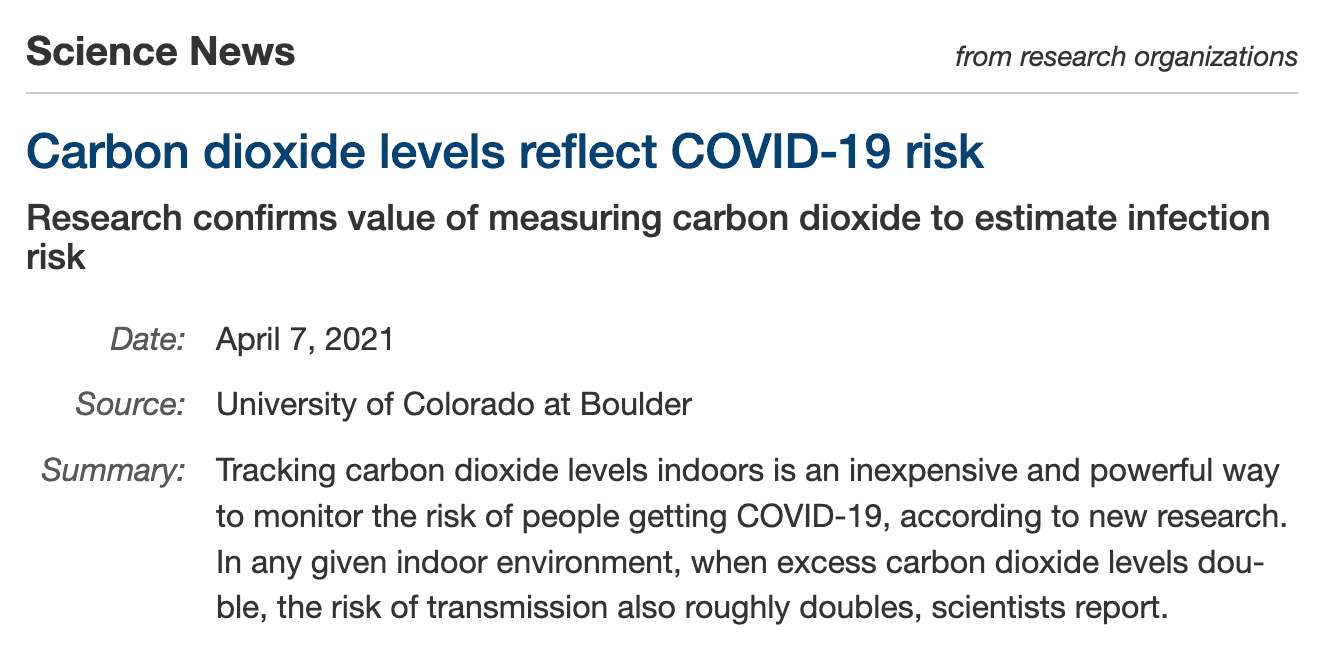
Research confirms value of measuring carbon dioxide to estimate infection risk.


Tracking carbon dioxide levels indoors is an inexpensive and powerful way to monitor the risk of people getting COVID-19, according to new research from the Cooperative Institute for Research in Environmental Sciences (CIRES) and the University of Colorado Boulder. 

In any given indoor environment, when excess CO2 levels double, the risk of transmission also roughly doubles, two scientists reported in Environmental Science & Technology Letters.

The chemists relied on a simple fact already put to use by other researchers more than a decade ago: Infectious people exhale airborne viruses at the same time as they exhale carbon dioxide. That means CO2 can serve as a "proxy" for the number of viruses in the air.

"You're never safe indoors sharing air with others, but you can reduce the risk," said Jose-Luis Jimenez, co-author of the new assessment, a CIRES Fellow and professor of chemistry at the University of Colorado Boulder.

You can read more here: https://www.sciencedaily.com/releases/2021/04/210407143809.htm

« Back to Blog

Related Articles

Carbon

How do carbon dioxide levels effect cognitive performance?

1 minute read

02/13/2025 10:13pm

Where Should I Put a CO2 Monitor in a Large Room?

Where Should I Put a CO2 Monitor in a Large Room?

1 minute read

02/13/2025 6:33pm

Routes

Routes of transmission and their relative importance

2 minute read

02/13/2025 10:40pm

  • Contact Us
  • Privacy Policy
  • Shipping Policy
  • Return and Refund Policy
  • Terms of Service
  • Twitter
  • Facebook
  • Instagram
  • Vimeo
© 2026, Airspothealth
  • Choosing a selection results in a full page refresh.
  • Opens in a new window.