
From Carbon Dioxide to Virus Detection: The Next Frontier in Indoor Air Quality
For decades, we've judged indoor air by how it smells, how comfortable it feels, or more recently, by how much carbon dioxide (CO₂) is present. CO₂ monitoring has transformed our understanding of ventilation because it provides a simple, affordable indicator of how much exhaled air we are sharing with others.
But imagine if, instead of estimating risk indirectly, we could actually detect airborne viruses themselves.
That future is getting closer.
Why CO₂ Isn't the Whole Story
CO₂ monitors don't detect viruses. They measure the concentration of exhaled air in an indoor space, allowing us to estimate the likelihood that airborne pathogens may also be accumulating.
This makes CO₂ an invaluable tool for improving ventilation, but it doesn't answer questions such as:
Is there actually influenza in this room?
Has someone with COVID-19 recently occupied this space?
Is RSV circulating through this classroom?
Has a new respiratory virus begun spreading within this building?
To answer those questions, we need environmental biosurveillance.
The Challenge
Detecting viruses in air is extraordinarily difficult.
Unlike carbon dioxide, viruses are present in incredibly small numbers. A room may contain millions of litres of air but only a handful of infectious viral particles. Any detection system must therefore:
Sample enormous volumes of air.
Efficiently capture microscopic aerosols.
Preserve fragile viral particles.
Detect minute quantities of viral material.
Ideally determine whether the virus is still infectious.
It's a remarkably difficult engineering problem—but one that researchers around the world are steadily solving.
Where the Technology Is Today
Recent years have seen enormous progress.
Smarter Air Sampling
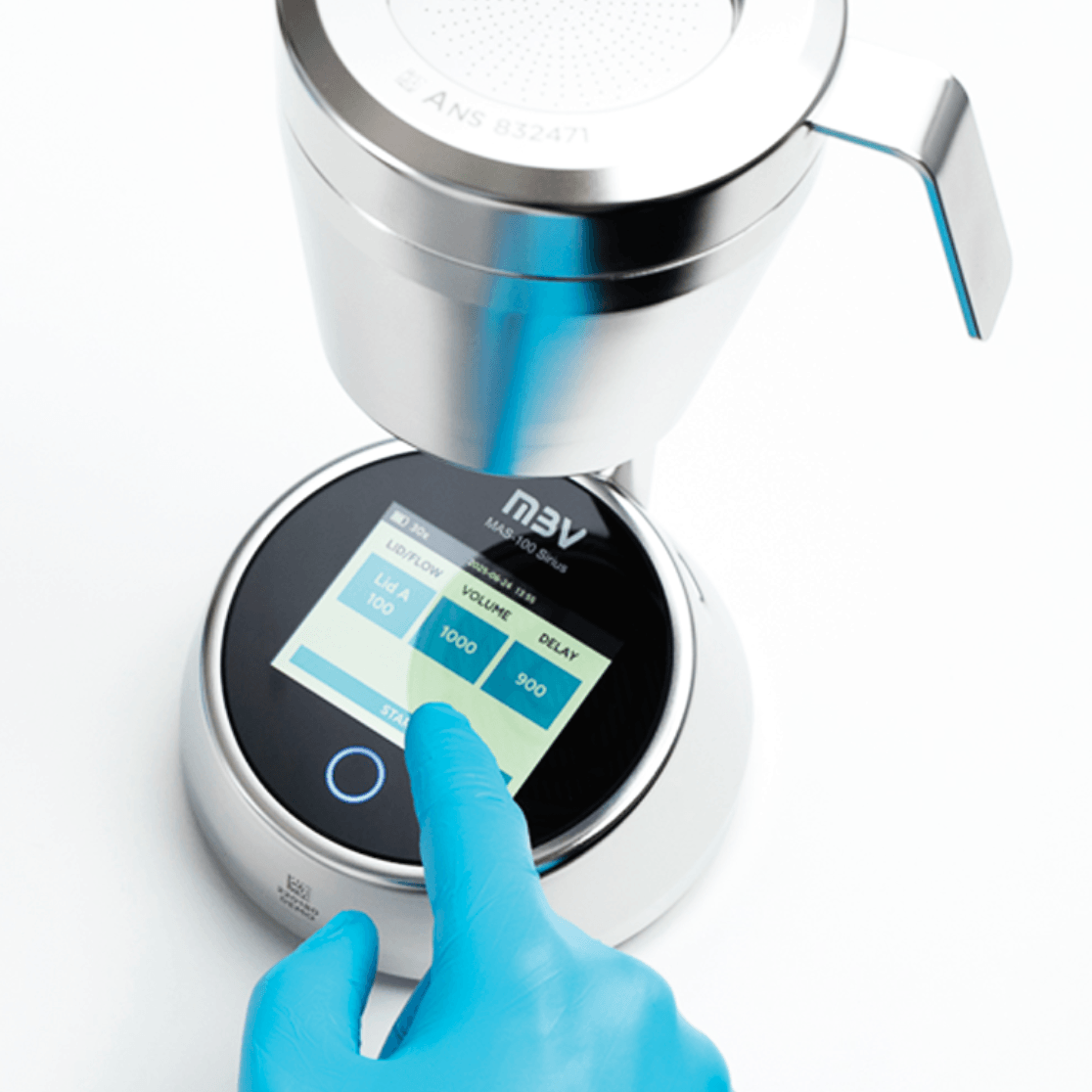
Modern aerosol samplers can now process hundreds of litres of air every minute, concentrating airborne particles into tiny liquid samples suitable for laboratory analysis.
This dramatically improves sensitivity compared with earlier filter-based approaches and allows respiratory viruses to be detected over much shorter sampling periods.
Faster Molecular Detection
Once viruses have been collected, molecular techniques such as PCR and digital PCR can detect even tiny amounts of viral genetic material.
Many research systems can now produce results within 20–60 minutes instead of several hours.
CRISPR-Based Diagnostics
Gene-editing technology is also finding an unexpected new role.
CRISPR-based detection systems are capable of identifying specific viral RNA with remarkable sensitivity and specificity, potentially reducing costs while making portable detection systems increasingly feasible.
Although still largely confined to research laboratories, these technologies continue to advance rapidly.
Lab-on-a-Chip Systems
Perhaps the most exciting developments combine sampling, processing and detection into miniature disposable cartridges.
These "lab-on-a-chip" systems integrate:
Air collection
Sample preparation
Viral detection
Automated analysis
into a single compact device.
While still emerging, this technology has the potential to make environmental pathogen monitoring dramatically simpler.
The Missing Piece: Infectious Virus
Most current systems detect viral RNA rather than live virus.
This distinction is important.
Finding viral genetic material tells us that virus has been present. It does not necessarily tell us whether that virus remains capable of infecting someone.
Determining infectivity still relies largely on growing virus in specialised laboratories—a process that may take several days.
Developing rapid methods to measure infectious viral particles remains one of the biggest challenges in airborne disease surveillance.
Looking Ahead
Researchers are increasingly working towards integrated systems capable of continuously:
Sampling indoor air
Detecting multiple respiratory viruses simultaneously
Reporting results automatically
Uploading information to cloud-based dashboards
Providing early warning of emerging outbreaks
Rather than simply reporting carbon dioxide levels, tomorrow's buildings may also report the presence—or reassuring absence—of circulating respiratory pathogens.
What This Could Mean
Imagine entering a school, office or hospital and seeing information such as:
Ventilation: Excellent
CO₂: 540 ppm
Influenza: Not detected
RSV: Not detected
COVID-19: Not detected
Overall respiratory risk: Low
While we are not there yet, each year brings us closer.
Building the Platform for Tomorrow
At AirSpot, our immediate focus remains helping people understand and improve indoor air quality through practical, affordable tools such as CO₂ monitoring, ventilation assessment and clean air interventions.
Through ICAAN (the Indoor Clean Air Adoption Network), we're also building an open platform designed to integrate many different sources of indoor environmental information.
Today that includes air quality data.
Tomorrow it may include building ventilation performance, filtration status, occupancy trends, weather conditions and, eventually, environmental pathogen surveillance.
The exact technologies will continue to evolve—but the vision remains the same: giving communities the information they need to create healthier indoor spaces.
Clean Indoor Air Is Becoming Measurable
Twenty years ago, continuous CO₂ monitoring in schools and workplaces was uncommon.
Today it is becoming standard practice in many parts of the world.
Environmental virus monitoring may follow a similar path.
The science is progressing rapidly. Engineering challenges remain, but each breakthrough brings us closer to a future where indoor environments can be monitored not only for ventilation quality, but also for the airborne pathogens that affect our health every day.
That future isn't here yet.
But for the first time, it is beginning to look achievable.